
The Rhythm of the Mind: Understanding Brain Waves, Stress, and Mental Well-being
The Rhythm of the Mind: Understanding Brain Waves, Stress, and Mental Well-being
How our brain’s electrical activity connects with our emotions, our response to stress, and our overall sense of well-being.
1. The lived experience: When emotions affect the way we think
Imagine preparing for an important conversation. You have thought about what you want to say, perhaps even rehearsed it in your head. But the moment the conversation begins, your heart starts racing, your thoughts become difficult to organise, and the words you had prepared seem to disappear.
Later, when you are alone and calmer, you can think of everything you wanted to say.
What changed?
The situation may not have changed very much. Your ability to think may not have disappeared either. Yet, in that moment, your emotional state seemed to affect how easily you could access your thoughts, process information and respond.
Experiences like these remind us that thinking and feeling are not separate processes that operate independently of each other. Our emotions, bodily responses, attention and thoughts continually influence one another.
When we feel threatened, embarrassed, overwhelmed or uncertain, our attention may narrow towards what seems most important or dangerous. We might find ourselves anticipating the worst, struggling to concentrate or reacting before we have had time to consider our options.
This does not necessarily mean that something is wrong with us. It may reflect how our brain and body are responding to a situation they perceive as significant.
Understanding this relationship offers a useful starting point for exploring brain waves and mental well-being. It also invites us to look beyond the idea that we should always be calm, rational or in control of our emotions.
2. Understanding brain waves: The brain’s electrical activity
The brain is made up of billions of nerve cells, or neurons, that communicate through electrical and chemical signals. When large groups of neurons produce coordinated electrical activity, some of that activity can be measured at the scalp using a technique called electroencephalography, or EEG.
An EEG records changes in electrical potential over time. Researchers can examine these signals for patterns that vary in frequency, amplitude and timing.

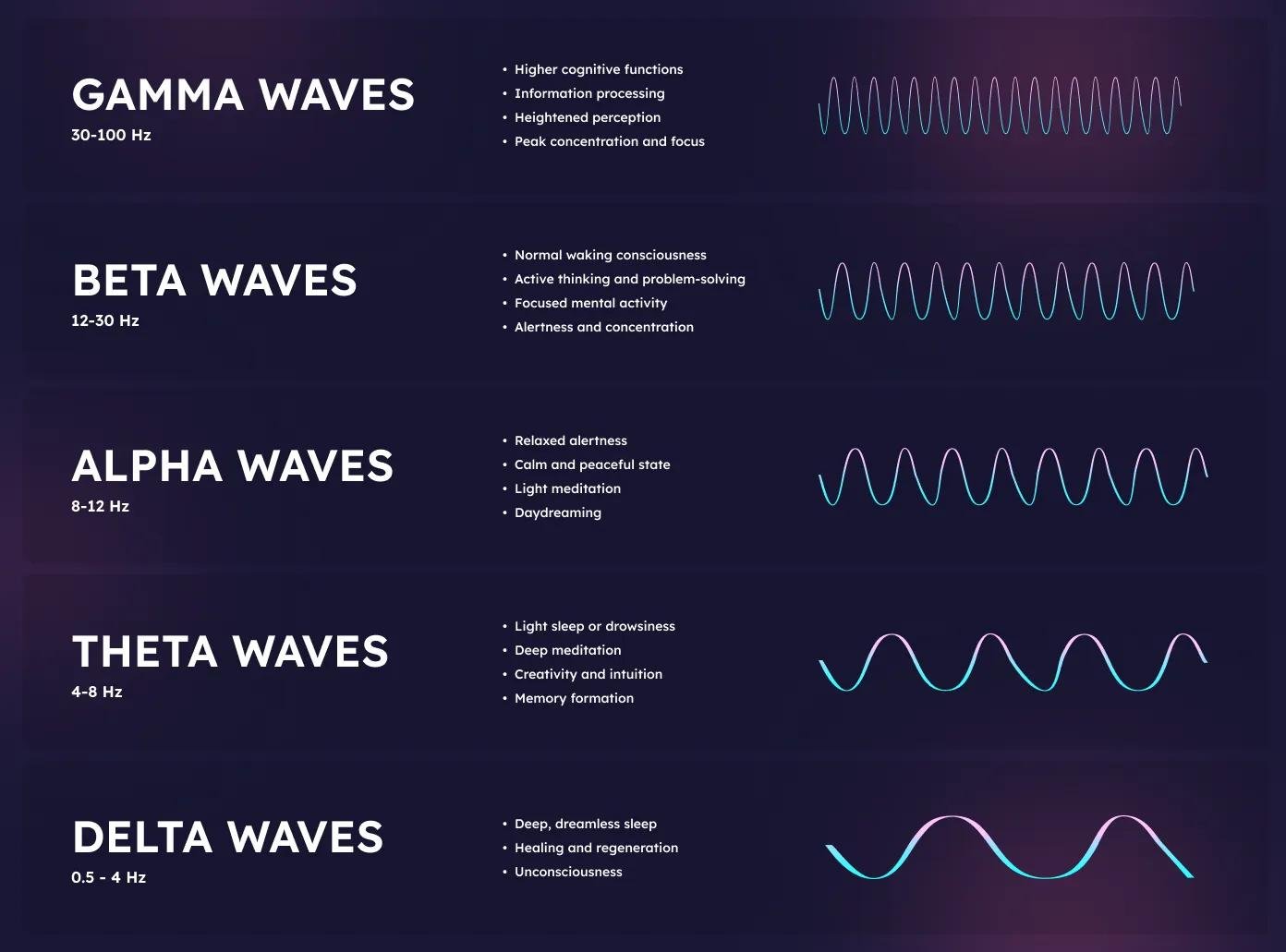
Brain waves are commonly discussed in terms of frequency, measured in hertz (Hz). Frequency tells us how many cycles of a repeating pattern occur per second. Researchers often group EEG activity into five broad frequency bands:
- Delta (approximately 0.5–4 Hz): Slow-frequency activity commonly associated with deep, non-REM sleep in healthy adults.
- Theta (approximately 4–8 Hz): Activity that can occur during drowsiness, some stages of sleep and various attention- and memory-related processes.
- Alpha (approximately 8–13 Hz): Activity often observed when a person is awake but relaxed, particularly with their eyes closed.
- Beta (approximately 13–30 Hz): Activity associated with several forms of active cognition and alertness, although its interpretation depends on the brain region, task and other conditions.
- Gamma (often around 30 Hz and above): Higher-frequency activity studied in relation to processes such as perception and the integration of information. Its measurement can be particularly vulnerable to interference from muscle activity.
These ranges are approximate. Researchers do not always use exactly the same boundaries, and the bands are not independent switches that turn particular mental states on and off.
It is tempting to imagine that a relaxed person has only alpha waves, an anxious person has too much beta activity, and a sleeping person has only delta waves. The reality is more complicated. Different patterns of activity can occur simultaneously across different brain regions, and their significance depends on the context in which they are measured.
Brain waves therefore offer one way of studying brain function, not a complete explanation of a person's thoughts, feelings or psychological experiences.
3. Stress and overthinking: When the mind starts looking for danger
Consider a person who receives a brief message from someone important to them: “We need to talk.”
Before the conversation has even happened, they may begin imagining possible explanations. Did they do something wrong? Is the relationship in trouble? Has something serious happened?
The mind starts filling in the gaps, often with possibilities that feel threatening.
When we perceive a situation as dangerous or uncertain, the body's stress-response systems can become activated. Heart rate and muscle tension may increase, breathing may change, and attention may become more focused on potential threats. These responses can be useful when quick action is needed.
However, the same heightened state can make it harder to step back, consider alternative explanations or hold several possibilities in mind. If a person is preoccupied with a perceived threat, less attention may be available for the task in front of them.
This is one reason overthinking can feel so exhausting. A person may repeatedly examine the same situation without reaching a useful conclusion. Each new thought seems to promise certainty, but the process may instead reinforce worry and keep attention fixed on the problem.
It is important to distinguish between thinking carefully and becoming caught in repetitive thinking. Reflection can help us understand a situation, make decisions and learn from experience. Rumination, by contrast, often circles around distress without moving towards resolution.
Brain activity changes as we attend, interpret, remember and respond to situations. EEG research has explored differences in frequency-band patterns across several psychiatric conditions, but the findings are varied and overlap between conditions. They do not support the conclusion that one particular brain-wave pattern explains every person's anxiety or overthinking.
Stress is not simply a matter of having the wrong brain waves. It involves the interaction of our interpretation of events, previous experiences, bodily responses, environment and available coping resources.
4. Emotional regulation: Feeling something is not the same as acting on it
Emotional regulation is sometimes misunderstood as the ability to remain calm or prevent uncomfortable feelings from arising.
But emotions are not problems that need to be eliminated. Fear can alert us to danger. Anger can signal that a boundary may have been crossed. Sadness can accompany loss, disappointment or change. Even anxiety can reflect the importance we attach to an uncertain outcome.
The difficulty is not necessarily in experiencing an emotion. It is in what happens when that emotion becomes difficult to understand, tolerate or respond to constructively.
Imagine receiving criticism at work. You might feel embarrassed, angry or defensive. Those feelings are real, but they do not automatically determine what you do next. You could react immediately, withdraw from the conversation, or pause long enough to understand what has been said and decide how to respond.
Emotional regulation involves processes that influence which emotions we experience, when they arise and how we express or respond to them. It can include recognising a feeling, understanding what may have triggered it, reconsidering an interpretation, tolerating discomfort and choosing an action that fits the situation.
This does not mean suppressing every emotional response. Nor does it mean that we should always respond perfectly. Sometimes we recognise our feelings only after we have reacted. Sometimes we need time, support or practice to find a different response.
From a psychological perspective, an important skill is learning to create space between an emotional experience and an action. The emotion can be acknowledged without allowing it to make every decision.
This is also where psychological support can be useful. Counselling can help people explore recurring patterns, understand their interpretations of events, develop coping strategies and practise responses that better reflect their needs and values.
5. Sleep and recovery: Why everything can feel harder after a poor night
Have you noticed how a small inconvenience can feel disproportionately upsetting after a night of poor sleep?
A delayed reply, an untidy room or a difficult conversation may require more patience than usual. Concentration may be harder to sustain, and the effort involved in thinking through a problem can feel greater.
Sleep is not simply a period in which the body switches off. It supports several processes involved in attention, learning, memory and emotional functioning. Research suggests that insufficient or disrupted sleep can affect emotional reactivity and our ability to regulate responses to challenging situations.
When we are tired, we may find it harder to pause before reacting, consider another person's perspective or keep an immediate frustration in proportion. Negative experiences may feel more intense, although the precise effects vary between individuals and studies.
Sleep and emotional well-being also influence one another. Stress can make it harder to sleep, while disrupted sleep can leave us more vulnerable to stress the following day. This can create a cycle in which emotional distress and poor sleep reinforce each other.
Recognising this relationship can change the way we interpret our own reactions. A difficult day does not always reveal a deeper truth about our lives, relationships or abilities. Sometimes it also reflects the fact that we are tired and have fewer resources available to manage what is happening.
This is not a reason to dismiss every concern as a consequence of poor sleep. It is a reminder to consider the broader context before drawing conclusions about ourselves or others.
6. Supporting well-being without trying to control every thought
If our thoughts, emotions, bodily states and environment continually influence one another, supporting mental well-being cannot be reduced to one technique or a single ideal mental state.
The aim is not to monitor every thought, eliminate all discomfort or achieve perfect calm. It is to develop habits and resources that make it easier to care for ourselves and respond to life's demands.

Some practical starting points include:
Prioritise restorative sleep. Maintain a reasonably consistent sleep and wake schedule where possible, create a routine that allows time to wind down, and pay attention to persistent sleep difficulties. Good sleep habits can support emotional functioning, although they are not a substitute for assessment when sleep problems continue.
Move your body. Walking, stretching, dancing or another form of enjoyable movement can provide a break from repetitive thinking and support general health. The goal does not need to be an intense workout; consistency and accessibility matter.
Notice what is happening before reacting. When emotions become intense, try identifying what you are feeling and what you have noticed in your body. If appropriate, take a moment before responding. Even a short pause can help you decide what you want to do next.
Practise reflection without turning it into rumination. Journalling can help organise thoughts, identify patterns and clarify what is within your control. It may help to ask: “What do I know?”, “What am I assuming?” and “What is one useful step I can take?” If writing repeatedly deepens distress, another approach or support may be more helpful.
Stay connected. Talking to a trusted person can offer perspective and reduce the sense of carrying a difficulty alone. Support does not always require advice or solutions; sometimes being heard is an important part of coping.
Consider professional support when needed. If anxiety, low mood, sleep difficulties or repetitive thinking persist, interfere with daily functioning or feel difficult to manage alone, a qualified mental health professional can help assess what is happening and explore appropriate support.
Mindfulness-based approaches may help some people with stress, anxiety or depressive symptoms, but their effects vary and they are not universally helpful for everyone. Mindfulness is also not about forcing the mind to become blank. It involves learning to notice thoughts, sensations and emotions without automatically treating each one as a command or a fact.
These practices do not need to be approached as another list of tasks at which we must succeed. They are options for supporting ourselves, not measures of how well we are living.
7. Critical reflection: Are alpha waves good and beta waves bad?
Popular discussions of brain waves sometimes assign each frequency a simple meaning: alpha is calm, beta is stress, theta is creativity, and delta is healing. Some claims go further, suggesting that listening to a particular frequency can correct the brain and resolve psychological difficulties.
Such explanations can sound convincing because they offer a simple answer to complicated experiences. They can also make neuroscience seem more immediately useful than the available evidence supports.
The difficulty is that brain activity does not operate according to a simple good-versus-bad classification. Alpha activity, for example, is observed in several contexts, and its meaning depends on factors such as the location of the recording, the person's state and the task being performed. Beta activity is not inherently harmful; it can occur during normal waking cognition. No single frequency tells us whether a person is emotionally healthy.
Research reviewing EEG frequency bands across psychiatric conditions has found substantial variation within conditions and overlap between different conditions. The authors also describe methodological challenges that limit how confidently frequency-band differences can be interpreted at the individual level (Newson & Thiagarajan, 2019).
There is another important distinction: observing a brain-activity pattern is not the same as proving that changing that pattern will improve mental health. Even when a relationship is found, it does not automatically establish cause and effect.
Some brain-based interventions are legitimate areas of clinical research and practice. But claims about specific sound frequencies, playlists or consumer devices should be evaluated individually. The existence of brain waves does not, by itself, demonstrate that a particular frequency is a proven treatment for anxiety, depression or another mental health concern.
A scientific approach requires us to ask what was measured, in whom, under what conditions, compared with what, and with what evidence of meaningful benefit.
Neuroscience can enrich our understanding of mental health. It should not be used to give unsupported certainty to claims that are still being investigated.
8. Conclusion: Well-being is not the absence of every difficult feeling
Perhaps mental well-being is not about maintaining a permanently quiet mind. Human beings experience uncertainty, disappointment, excitement, grief, anger, love and fear. These experiences are part of being alive, and they cannot all be prevented or controlled.
What matters is how we relate to these experiences, the resources we have available to navigate them, and whether we can find ways to respond that support our needs, relationships and responsibilities.
Understanding brain waves offers one small window into the activity of a complex organ. Understanding mental well-being requires us to look beyond electrical patterns, towards the person experiencing them and the circumstances in which they live.
We can learn to recognise when stress is affecting our attention, when exhaustion is making things harder, and when a recurring pattern of thought may be keeping us stuck. We can seek support, practise new ways of responding and acknowledge that progress does not always look like calmness.
The goal is not to silence the brain. It is to understand what we are responding to, learn how to respond to ourselves with greater awareness, and make room for the full range of being human.
This article is for educational purposes and is not a substitute for individual medical or mental health assessment.